AI & Machine Learning
AI in Construction: Project Planning, Cost Estimation, and Safety
Published:
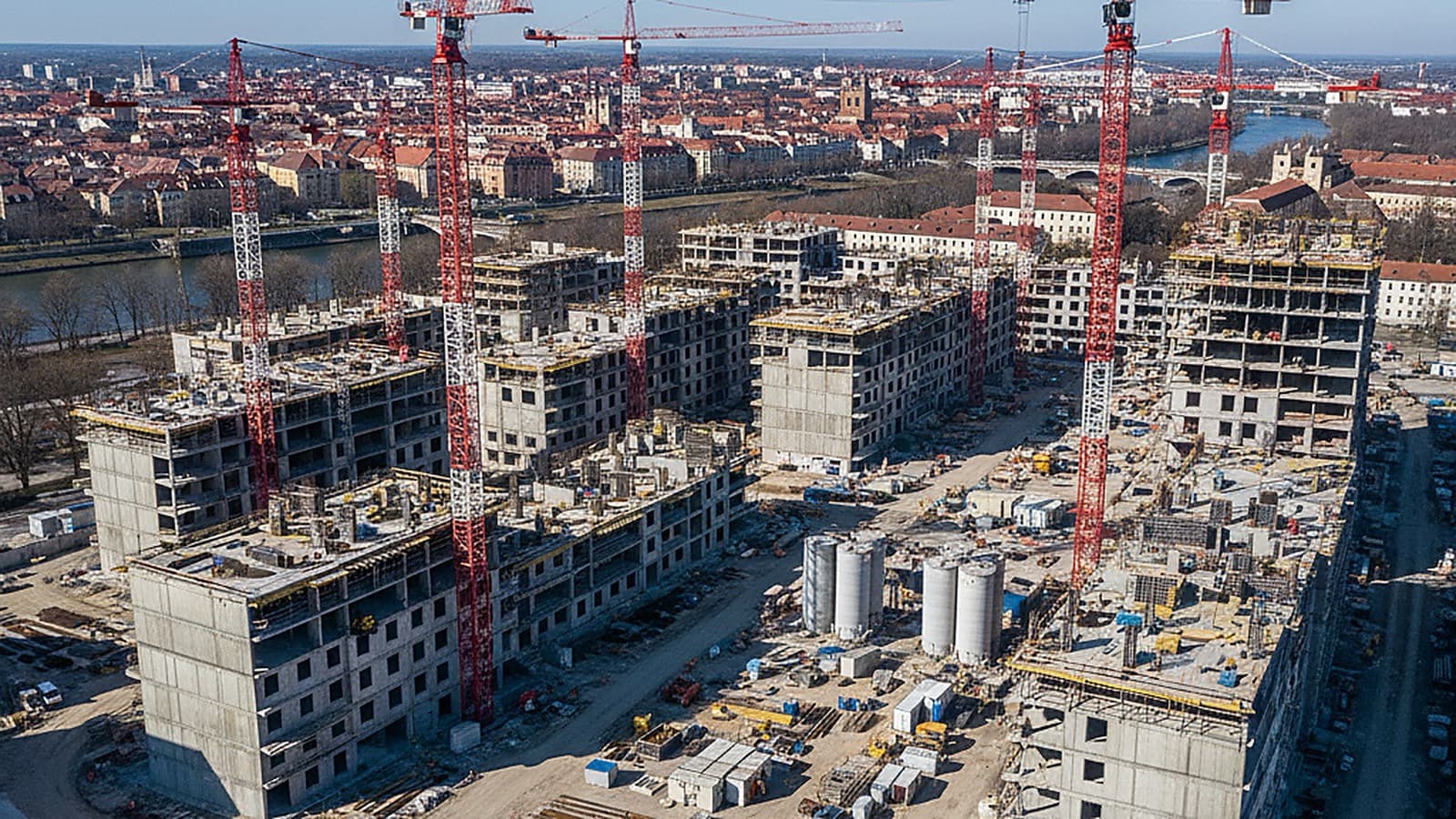
Key Takeaways: AI addresses three of construction's most persistent problems: project delays, cost overruns, and safety incidents. AI-powered planning reduces delays by 20-30%, cost estimates become 15-25% more accurate, and computer vision for safety monitoring lowers incident rates by 25-50%. This article covers five concrete applications, outlines how construction companies can implement step by step, and identifies Dutch subsidies available to lower the investment.
AI-Powered Project Planning and Scheduling
AI-powered project planning analyzes thousands of historical projects to predict realistic timelines and identify scheduling risks early. Construction companies deploying this technology report 20 to 30 percent fewer delays and substantially better predictability of completion dates.
The construction sector has a structural problem with delays. McKinsey research shows that 98% of large construction projects experience cost overruns or delays, with an average overrun of 80% on the original schedule. The causes are complex: weather dependence, material deliveries, subcontractors, permits, and unforeseen conditions create a web of interdependencies that human planners cannot fully oversee.
Machine learning models for construction planning work fundamentally differently from traditional CPM networks or Gantt charts. They incorporate not just the logical sequence of activities, but also probabilistic estimates of durations based on historical data. The model weighs factors such as the season, foundation type, subcontractor experience, local weather patterns, and even the availability of specific equipment in the region.
Skanska, one of the world's largest construction companies, implemented AI planning across their project portfolio and reported a 25% improvement in delivery prediction accuracy. The system identified scheduling risks an average of six weeks earlier than traditional methods, enabling the project team to adjust proactively. The investment per project ranged from 15,000 to 40,000 euros depending on project scope.
For Dutch construction companies, this application is particularly relevant given current market conditions. The shortage of skilled workers, rising material costs, and tightening regulations make accurate planning more urgent than ever. A regional construction firm that implemented AI planning for their residential projects saw average delays decrease from 14 weeks to 5 weeks. The improved predictability enabled better agreements with buyers and financiers.
Cost Estimation from Historical Data: 15-25% More Accurate
AI-powered cost estimation analyzes thousands of previous projects to produce more reliable budgets for new projects. Accuracy improves by 15 to 25 percent compared to traditional methods, which directly translates into more competitive bids and fewer surprises during execution.
The problem with traditional cost estimation in construction is the dependence on the experience and judgment of individual estimators. Experienced estimators build a mental model over years of what projects cost, but this model is inherently limited: it is based on personal experience, subjectively colored, and not scalable. When an estimator leaves, part of that knowledge disappears with them.
Machine learning models for cost estimation are trained on historical project data: budgets, actual costs, project characteristics, location, timing, and hundreds of other variables. The model learns which factors have the greatest impact on final costs and how these factors interact. A rise in steel prices, for instance, has a different impact on an office building than on a residential project, and the model learns these nuances.
Turner Construction, one of the largest construction firms in the US, implemented AI cost estimation and saw early estimate accuracy improve from plus or minus 25% to plus or minus 10%. This enabled them to communicate more reliable cost expectations in earlier project phases, significantly improving client relationships. The system was trained on 20 years of project data spanning more than 5,000 projects.
Dutch construction companies typically work with less project data, but this need not be a barrier. Specialized AI platforms for construction combine your own data with anonymized industry data to achieve sufficient training volume. The average cost overrun in Dutch construction runs 10-15%. AI cost estimation can reduce this to 3-7%, which on a 10 million euro project represents savings of 300,000 to 800,000 euros.
Implementation begins with digitizing and structuring your historical project data. Many construction companies have this data scattered across Excel files, ERP systems, and project administration tools. Centralizing and standardizing this data is the first and often most labor-intensive step, but it creates a valuable business asset independent of the AI application.
Safety Monitoring with Computer Vision
Computer vision for safety monitoring on construction sites detects dangerous situations, missing personal protective equipment, and unsafe behavior in real time. Construction companies deploying this technology report 25 to 50 percent fewer safety incidents, an improvement that prevents both human suffering and financial damage.
Construction is structurally one of the most dangerous industries to work in. In the Netherlands, an average of 20 fatal workplace accidents occur in construction annually, along with thousands of non-fatal incidents. The costs of a serious workplace accident quickly exceed 100,000 euros in direct costs, on top of the impact on the victim and their team.
AI-powered safety cameras continuously analyze footage from the construction site and detect situations that violate safety standards. The system recognizes whether workers are wearing their helmets, safety vests, and harnesses, whether they are in prohibited zones, whether there are unsecured openings, and whether heavy equipment is operating safely. Detection occurs within seconds, after which an alert goes to the site manager or safety coordinator.
Suffolk Construction, an American construction company, implemented AI safety monitoring across 50 projects and saw OSHA-recordable incidents decrease by 40% in the first year. The system detected an average of 12 safety violations per day per project that would otherwise have gone unnoticed. The 30,000 euro investment per project was amply recovered through lower insurance costs and less downtime from incidents.
In the Dutch context, this technology is especially relevant due to stricter enforcement of workplace safety regulations. A violation of safety requirements can result in fines up to 36,000 euros per violation, and repeated violations lead to site shutdowns. AI monitoring not only helps prevent incidents but also systematically documents your safety efforts, which is valuable during inspections.
The technology has become significantly more affordable in recent years. Cloud services for image analysis from Microsoft, Google, and specialized providers like Smartvid.io offer pay-per-use models that lower the barrier to entry. A basic configuration with four cameras and cloud analysis costs 15,000 to 30,000 euros per construction site, including hardware and an annual license.
BIM Optimization with Machine Learning
Machine learning enhances Building Information Modeling by detecting design conflicts early, calculating material quantities more accurately, and generating maintenance suggestions based on historical data. The combination of BIM and AI increases design quality and reduces change order costs during execution.
Design errors and inter-discipline conflicts are a significant cost driver in construction. An average 50 million euro construction project incurs 5-10% additional costs from design changes discovered during execution. Traditional clash detection in BIM models catches structural conflicts but often misses functional, logistical, and constructability issues.
AI-powered BIM analysis goes beyond geometric clash detection. Machine learning models trained on thousands of projects recognize patterns indicating construction problems: unreachable maintenance points, suboptimal material choices, installation spaces too tight for assembly, or design solutions that caused problems in comparable projects. Autodesk reports that their AI-powered clash detection identifies 60% more potential issues than rule-based methods.
The Dutch construction sector leads internationally in BIM adoption, with a penetration rate exceeding 70% among large construction firms. This provides an excellent foundation for AI integration, as the required digital models are already available. The next step is enriching these models with machine learning that learns from experiences across previous projects.
Generative design is an emerging application where AI generates thousands of design variants based on specified constraints. The system optimizes simultaneously for cost, sustainability, construction time, and use quality, presenting the most promising variants to the design team. This approach accelerates the design process and produces solutions that human designers would not have conceived.
Automated Quality Inspection
Automated quality inspection with drones and computer vision transforms how construction quality is assessed. AI-powered inspections are faster, more consistent, and more accurate than manual inspections, and they automatically document findings for accountability and compliance records.
Manual quality inspections on construction sites are time-consuming, subjective, and limited by accessibility. An inspector cannot reach everywhere, particularly in high-rise or complex structures. Moreover, inspection quality varies between individuals and moments. AI eliminates this variability and provides an objective, reproducible assessment.
Drones equipped with high-resolution cameras scan the construction site and generate detailed 3D models compared against the BIM design. Machine learning models detect deviations: cracks in concrete, insufficient reinforcement cover, incorrectly placed installations, or facade elements that do not meet specifications. The accuracy of AI detection in trained models exceeds 90%, with false-negative rates below 5%.
DPR Construction automated their quality inspections with drones and AI and reported a 75% reduction in inspection time per phase. Where a manual floor inspection took two days, the drone inspection was completed in two hours. The system also identified 30% more defects than manual inspection, particularly in hard-to-reach locations.
For the Dutch market, this technology offers a solution to the shortage of experienced inspectors. Quality assurance under the Dutch Quality Assurance for Building Act requires extensive documentation and independent verification. AI-driven inspection automatically generates the required reports and visual documentation, significantly reducing the administrative burden on the construction company.
Getting Started with Construction AI: A Pragmatic Implementation Plan
Successful AI implementation in construction requires a pragmatic approach that accounts for the project-based work method and the sector's relatively low digitalization level. Start small, prove the value, and scale up.
The first step is data inventory and centralization, during months one and two. Map out what project data you have available, in which systems it resides, and how accessible it is. Centralize historical project data in a structured format. This is an investment that delivers value even without AI applications, through knowledge retention and benchmarking.
The second step is a pilot on an active project, during months two through five. Select an application with high impact and relatively low complexity. Safety monitoring with cameras is often a strong starting point: results are immediately visible, investment per project is limited, and the societal value is evident. Cost estimation is another good starting point if you have sufficient historical data.
The third step is evaluation and scaling, during months five through nine. Measure pilot results carefully and compare with similar projects without AI. Based on the results, decide on scaling to additional projects and potentially adding a second AI application.
The fourth step is integration into standard work processes, during the second half of the year. Integrate successful AI applications into your standard project approach. Train project managers and site supervisors in using the tools. Develop internal procedures for data collection so that each new project contributes to the quality of your AI models.
Subsidies for Construction AI: WBSO, MIT, and More
Dutch construction companies have access to several subsidies that make AI investments significantly more attractive. Combining multiple programs can cover 30-50% of the total investment.
The WBSO is the most valuable program for construction companies developing or implementing AI. Developing a cost estimation model trained on your own project data, a computer vision system for safety inspection, or an AI planning tool qualifies as technical innovation. The benefit amounts to 32% on the first 350,000 euros in R&D labor costs for SMEs. Construction companies often underestimate that their specific AI applications qualify, because the technical novelty lies in the application to their specific context, not in inventing entirely new AI.
The MIT program offers two relevant variants. The feasibility study subsidizes 35% of costs to investigate which AI applications are most valuable for your construction company, up to a maximum of 20,000 euros. The collaborative R&D variant subsidizes larger projects in partnership with knowledge institutions such as TU Delft or TNO, which actively research AI in construction.
The SLIM subsidy is particularly relevant for the construction sector, where the digital skills of the workforce structurally lag behind other sectors. At 60% subsidy for SMEs, this program makes it affordable to upskill project managers, site supervisors, and estimators in working with AI tools and data-driven decision-making.
Stacking subsidies maximizes the benefit. Start with a MIT feasibility study to validate the business case, use WBSO for the development phase, and SLIM for team training. Stratalytic guides construction companies through the entire process, from technical implementation to subsidy applications. Visit our construction sector page or contact us directly for a no-obligation conversation about the possibilities.
Get the AI-subsidy radar
1 email per month. New subsidies, deadlines, and what changed for SMEs. 5-minute read.
Unsubscribe with one click. No spam, ever.
Keep reading
Related articles

AI & Machine Learning
Computer Vision for Quality Control: Costs and Returns in Manufacturing
Discover how computer vision transforms defect detection in manufacturing, what implementation costs, and when the investment pays for itself.
Read more →
AI & Machine Learning
AI in Healthcare: 7 Concrete Applications for Dutch Healthcare Organizations
From diagnostic support to workforce scheduling: discover 7 proven AI applications that Dutch hospitals and healthcare institutions are deploying now to improve care and reduce costs.
Read more →

AI & Machine Learning
AI Sales Forecasting for SMEs: More Accurate Predictions on a Limited Budget
How AI-driven sales forecasting works, what it costs and how SMEs can get started immediately. With method comparison, realistic accuracy improvements and available subsidies.
Read more →

Let's talk business
Do you want to know how we can help you grow your business? Schedule free consultation with one of our experts and discover the possibilities.